Rius
Agent observability: every LLM call, tool invocation, and agent step, traced end to end.
Rius by GlassFlow® is the agent observability product in the GlassFlow family.
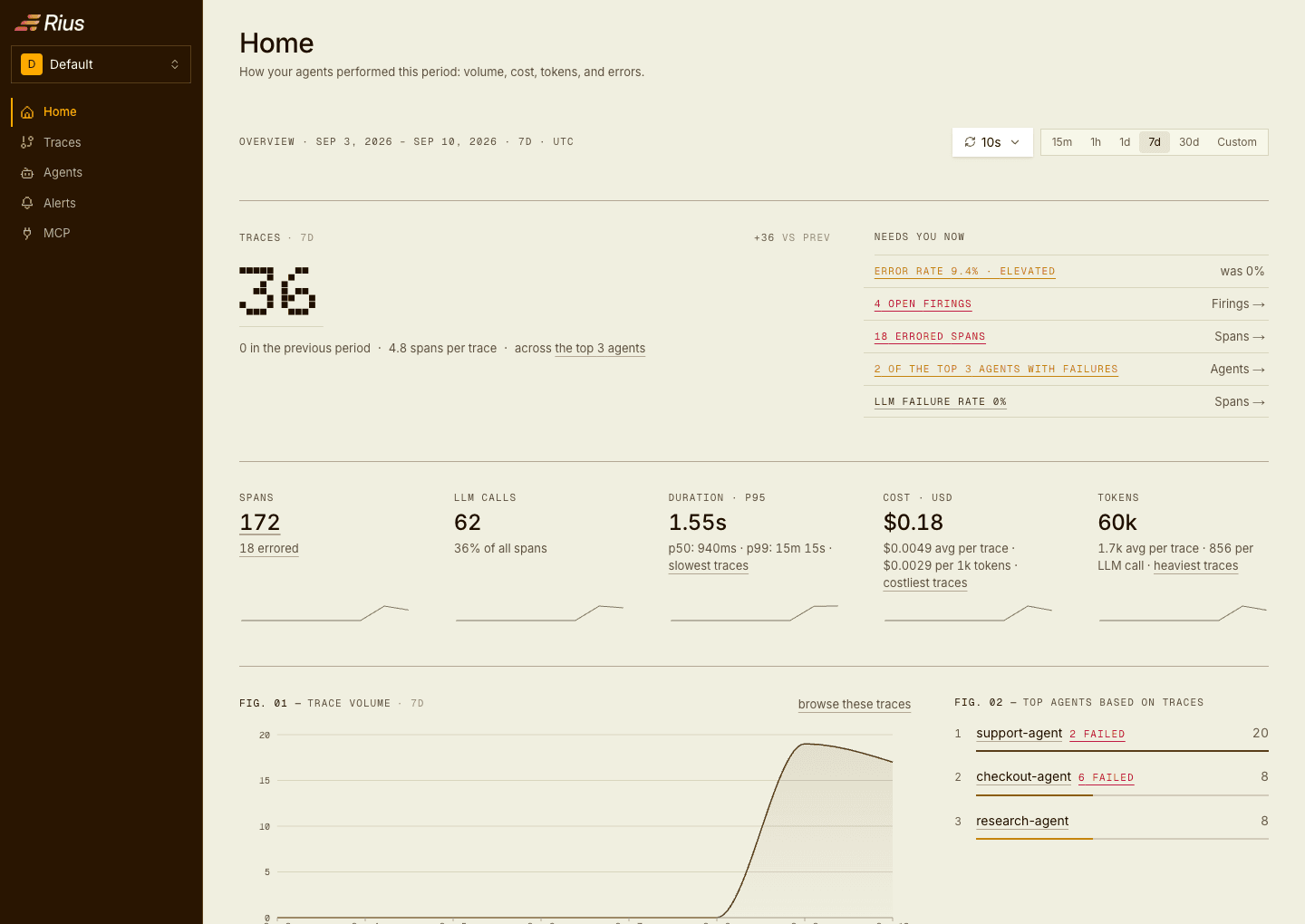
Your agents send OpenTelemetry GenAI traces, through the glassflow-rius
SDK or any OpenTelemetry SDK or collector, and Rius turns them into
something you can interrogate: ask why did this run cost $4? and walk
one waterfall from the failing root span to the exact generation, with
its prompt, token counts, and cost on the span. You never send a cost or
a latency value: cost is computed server-side from the model and token
usage, and time to first token is derived from the first-token event the
instrumentors stamp on streamed generations.
Traces tell you what an agent did; heartbeats tell you whether the process is alive right now, ready, mid-run, or gone. And the MCP server turns the whole thing conversational: connect Claude, Cursor, or your editor and ask about your telemetry from where you already work.
Rius is a managed platform: create an account, mint an API key, send traces. Nothing to host.
How it works
- Instrument:
init()once; the SDK auto-instruments the LLM libraries you already use (OpenAI, Anthropic, LangChain, and friends) andobservecovers your own functions. No SDK? Raw OTLP and third-party instrumentation land with the same analytics. - Ingest: traces post to the OTLP receiver at
https://ingest.eu.console.rius-glassflow.com/v1/traces(the SDK’s default), authenticated by an API key; the key decides the workspace, and content-privacy controls are applied before anything leaves your process. - Explore: the console renders the trace list, waterfall, map view, and span detail, with cost, tokens, and time to first token (TTFT) computed server-side.
- Monitor, alert, and ask: the Agents view classifies every instrumented process by liveness, Home tracks volume, cost, and errors per period, alerts fire on recurring errors, silent failures, tool loops, and thresholds you set, and the MCP server answers questions over all of it in plain language.
Data model
- A workspace is where traces live; every trace belongs to exactly one, determined by the API key that sent it.
- A trace is one run of your agent; a span is one step of it.
- A generation is a span that records an LLM call: model, token usage, and (subject to your privacy controls) prompt and response.
- An agent instance is one heartbeating process; instances group under an agent name.
- Cost and time to first token are derived server-side, from token usage and the first-token event; you never send the values.
Full definitions are in Concepts.
Documentation
- Quickstart: from zero to your first trace in four steps.
- Concepts: the data model in full.
- SDK: installation, tracing, integrations, privacy, reliability.
- Platform: the console, task by task: traces, agents, alerts, usage and cost, settings.
- MCP: connect an AI client and query your traces.
- Interoperability: send data without the SDK, via raw OTLP or third-party instrumentation.
- Guides: longer walkthroughs, including multi-tenant observability and migrating from Langfuse.
Need something Rius doesn’t do yet?
Missing integrations, questions, or feedback: email help@glassflow.ai. We’re building against real use cases and reply quickly.